
There’s a common statistic that is cited among the M&A community that 80% of businesses that go to market never sell. While I believe this statistic to be true, I also believe it is somewhat misleading. Why? Because I think an even higher percentage of businesses are in fact unsellable.
The planning gap hiding in plain sight
How can that be? Because they never go to market in the first place. Think of it like the unemployment rate, which only counts people actively looking for work. Plenty of others are unemployed but not job-hunting, and they don’t show up in that number either.
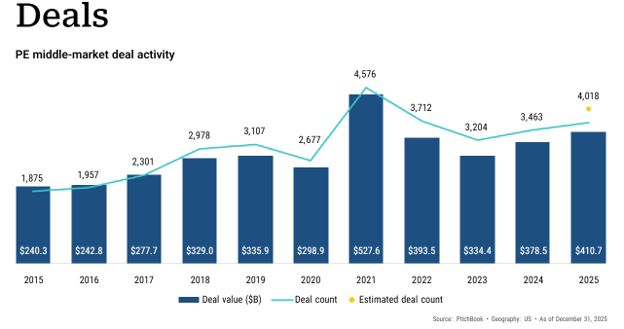
If you looked at recent Pitchbook data regarding M&A activity (transactions) in the Middle Market in 2025, you would see volume that has grown two consecutive years from the 2023 low (lowest since 2020). But that statistic is also misleading. Why? Because founder/owner businesses (mostly between $25mm-$100mm in enterprise value) accounted for nearly half of all Middle Market deals by count in 2025, yet just 16.9% of total deal value. Meaning, these businesses are transacting, but for a lower slice of overall dollars.
This Enterprise value range is predominantly represented by privately owned/bootstrapped family businesses. These are the majority of people and businesses that I deal with on a daily basis. These businesses are facing significant headwinds when attempting to exit.
Pitchbook data tells us that hold times for Private Equity firms have been rising steadily in recent years. This isn’t a blip. This means that they’ve had an increasingly difficult time finding buyers for these businesses, which runs counter to their entire model: raise capital, deploy it, and return it to investors on a defined timeline, typically in the 3-7 year range.
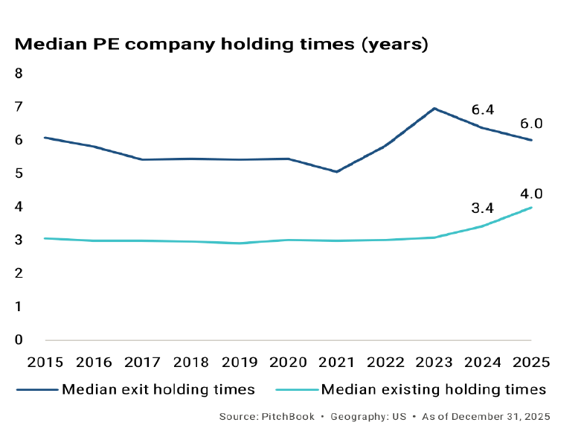
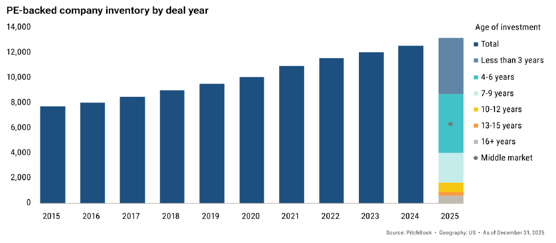
The result? Naturally, more scrutiny on the front end. Longer hold times mean PE firms have more unsold inventory competing for the same buyers, which raises the bar for any new deal to clear. Private equity has become increasingly more critical of businesses during the underwriting phase. We recently had a buyer walk away from diligence after a full year of underwriting, just weeks away from closing.
Fueling the 80% statistic is the lack of planning from business owners. The Exit Planning Institute estimates that 78% of businesses in the lower middle market lack a formal transition plan. Only 12-13% actually have a formal written plan. In short, business owners who have done proper and extensive exit planning are in the minority.
The most common question I’m asked is this; how far out should I start the planning process?
The answer is, it’s never too early, but generally speaking you want to at least 2-3 years out.
Three questions every owner needs to answer
Business owners need to be able to answer these three questions:
- What is my disaster plan?
- What is my growth plan?
- What is my exit plan?
Business owners who lack all or any of these three plans fail to see the big picture. Which is this, someday you will exit your business whether you like it or not, and you may not even get to choose when that is. But if you do get to choose when, don’t you want to do so on your own terms?
Lack of a disaster plan means that you aren’t prepared in case of emergency.
Lack of a growth plan means that you aren’t truly dedicated to growing and scaling.
Lack of an exit plan means that you stand a good chance of not exiting on your terms, or not at all (remember that 80% stat?).
Exit planning is primarily about de-risking the business. Some solutions such as securing key talent can often be implemented in fairly short order. Others, such as customer concentration in a B2B business, could take years to rectify.
Where to start
The most common deal killers in selling a business that I see are as follows.
- Poor financials: Most businesses start small and run on shoestring budgets, often with a “bookkeeper” who isn’t formally trained in accounting, or with no bookkeeper at all. As the business grows, financials need to be upgraded to accrual-basis accuracy, but many businesses never make that upgrade. With strong cash flow and no lender to appease, owners often see no need to fix what isn’t broken. That’s fine, until it’s time to borrow money or sell.
- Customer concentration (B2B businesses): Many B2B businesses enjoy great success in the form of cash flow and growth, but lay exposed due to high concentration in one or two customers. This represents risk to a buyer that is often hard to overcome, or at least affects value substantially. This is not a problem that is solved overnight as winning customers can be a multi-year endeavor.
- Internal shareholder & family issues: Shareholder disputes can take many forms, family, partners, or a mix of both, whether or not they’re active in the business. These are often made worse by the lack of a proper shareholder agreement. When it’s unclear who legally holds voting rights over a sale, the result can range from value erosion to deal destruction.
- Over reliance on the owner: A surprisingly common issue that destroys value and demonstrates a clear lack of planning. Perhaps the biggest reason you see businesses unsold, especially below $10mm in Enterprise Value.
- Lack of key talent retention plan: Even when a business isn’t owner-dependent, buyers almost always want to retain its key talent. Without a defined plan to keep them, a departure can derail the deal or gut its value.
There are competitive advantages in business as a going concern. But, there’s also a competitive advantage when it comes to exiting your business.
If I haven’t made it abundantly clear by now, those who plan ahead will enjoy a clear and distinct competitive advantage over their competitors when it comes time to sell.
As the old saying goes, “failing to plan is planning to fail.”