Leadership is one of those skills that most people believe they have, but very few actually do, and that’s unfortunate because leadership is an essential skill for entrepreneurs.
If you want to grow your company beyond a one person operation, you need the ability to effectively lead a team, and the larger your team grows, the more effective your leadership skills need to be because you’re further from the front lines.
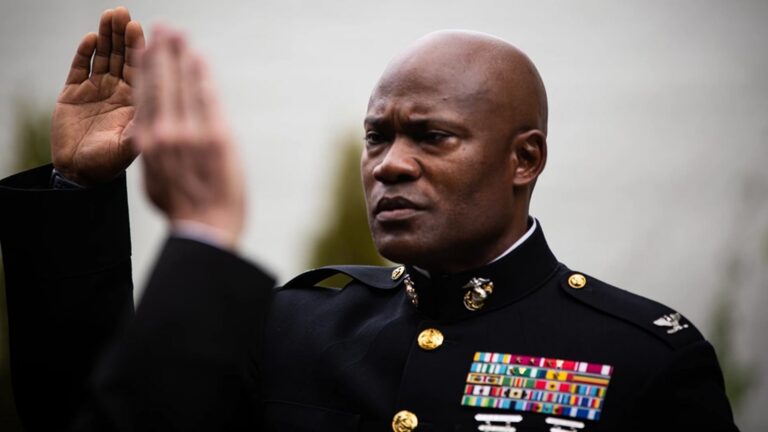
I’ve been fortunate to have experienced a wide range of leadership styles throughout my career. Some served as powerful examples to model, while others served as examples to avoid like the plague. But I learned something important from every single one of them. And without question, one of the most effective leaders I’ve had the opportunity to meet is Marine Corps General, Anthony Henderson, who I first met while I was serving in the Marine Corps when he took command of Lima Company, 3rd Battalion, 2nd Marines.
So what does military leadership have to do with leadership in the civilian world? Everything. Leadership is the same, whether you’re leading troops into battle or employees in the workforce.
Despite what you see in the movies, our troops don’t just jump into action because someone yelled at them to do a particular thing. In fact, due to the insanely dangerous nature of military service, more effective leadership is required compared to the civilian world.
Think about it like this—how much would I have to scream at you to get you to rush across an open field being pummeled by artillery and machine gun fire? If you’re anything like most people, your answer is probably something along the lines of, “There is no amount of screaming that will get me to do that!” Nothing I could say would get you to run across that field.
That’s because true leadership isn’t about forcing people to do something. It’s about inspiring them to make your mission their mission.
An effective leader is a boss, but also a mentor, protector, and cheerleader. Their job is to give orders, but first, they have to educate, train, and nurture their team.
And that’s exactly what he did, and his leadership is why every Marine I’ve ever met who served with him would still follow him into battle armed with nothing more than a pair of silkies and an MRE spoon.
So in this article, I’m going to break down five lessons I learned from one of the best leaders I’ve ever met; Marine Corps General Anthony Henderson. If you apply the lessons learned from the stories I share here, I can promise that you’ll become a better leader and build a more effective, productive, and cohesive team that will help propel you to your goals.
Blame belongs to you, praise belongs to your team
Over the four years I spent in my unit, I served under several commanding officers, each with a distinct leadership style.
My last commanding officer, who I won’t name, was one of the worst examples of leadership I’ve ever encountered. In fact, he demonstrated a complete lack of leadership. He would rarely show up for our training operations, and when he did, he wouldn’t do anything, which is not common behavior in our world. Fortunately, the other leaders in our unit stepped up to ensure everyone performed as expected, which was kind of important considering that we are talking about literal life and death scenarios.
I distinctly remember a particular battalion formation following a training operation, which was the culmination of several months of training in preparation for an upcoming deployment. Our unit had performed exceptionally well and our battalion commander congratulated him for our performance.
I was blown away by his response.
He said, “Thank you, sir! I put in a lot of work to make sure my Marines knew exactly what to do and how to do it. I personally supervised and trained them at every step of the way.”
Literally none of that was true. He played no role in our performance.
Henderson, on the other hand, was with us for nearly every training operation, alongside us enduring the physical and mental challenges that come with that. And while he was one of the best leaders I’ve ever met, he also often took a direct, hands on approach with the junior Marines as well.
When faced with a similar compliment from our battalion commander, Henderson responded very differently.
He said, “Thank you, sir! My Marines worked night and day to achieve this. They deserve all the credit.”
There was a stark contrast between these two responses.
For Henderson, it was never about himself—it was always about us and the mission.
A true leader understands that leadership is not about themselves and it’s not about barking orders. It’s about accomplishing the mission while taking care of those under your leadership.
You have to trust your team to do their jobs
Shortly after a change of command ceremony where our new commanding officer took over the command of our unit, I arrived back at our company office.
As I was getting ready to get back to work, he showed up in my peripheral vision, and with a calm, yet booming voice, said, “Lance Corporal Knauff, bring the MCI program documents and come see me in my office.”
This is basically an educational program where Marines take self study courses on their own time, and then take an exam on the topic in a controlled and supervised environment. Many of these courses are required for promotion.
I immediately began gathering the documents, and already knew exactly where this was going because the program was managed like a complete dumpster fire from the top at Headquarters Marine Corps in Washington DC.
This was hurting the careers of tens of thousands of Marines because the exams, once mailed back to Headquarters Marine Corps, would mysteriously disappear. While not a perfect solution, I began photocopying the exams before sending them off so that if they disappeared, I could resend them. There was another issue—the courses that Marines had already received a completion certificate for would suddenly and mysteriously disappear from the database. Fortunately, I anticipated this because of the previous issue, so I also began photocopying the certificates as well. As a result, I was able to compensate for the mismanagement at Headquarters Marine Corps and keep my Marines’ careers on track.
As I entered his office with a massive stack of documents in hand, he shot the kind of intense stare you’d expect from a Marine, and immediately began talking.
“We’re going to make some changes to how we handle the MCI program here. We’re going to do XYZ from now on. Do you have any questions?” he said.
Before I even realized I had begun speaking, I heard myself respond with, “No, Sir. We’re not going to do that, and here’s why. Here’s how I do it, here’s why I do it this way, and here’s the outcome we have as a result.”
He stared at me without saying a word long enough for me to reconsider the sanity of my response, because this simply isn’t how you respond to your commanding officer. Especially as a young Lance Corporal, and even more so, within the first thirty seconds of meeting him.
After what seemed like an eternity had passed, he simply nodded and said, “It sounds like you have this under control, Lance Corporal Knauff. Handle it your way.”
That was the end of that conversation.
An effective leader knows when their team is capable of handling a task, and trusts them to do so without feeling the need to micromanage.
Your team may do things differently than you would, and they will make mistakes. But that’s how they learn and improve. As a leader, you have to become comfortable with the uncertainty that comes from this.
You have to be comfortable being uncomfortable
In the Marine Corps, many words have very different meanings than they do in the civilian world.
Field day is one of those words.
While you as a civilian might think of field day as a party or celebration, in the Marine Corps, it means cleaning our living quarters, also known as the berthing area.
Like I said—very different meanings.
So while on one of my last deployments, we were assigned to the USS Wasp as the 22nd MEU(SOC). In a nutshell, the Marine Corps has specially trained combat units positioned strategically around the globe so that we can put boots on the ground anywhere in the world within twenty four hours.
While we did a lot of training in various countries during these deployments, we also spent a lot of time on the ship. It probably won’t surprise you to hear that we were expected to keep our berthing area spotless. That’s where the field day comes in. And on one particular day, following the field day, we had an unplanned company formation on the flight deck.
That’s because one Marine, PFC Stanley, had decided he wasn’t going to help clean our berthing area. He began cursing at the NCOs, telling us, “I’m not a slave and I’m not going to act like one for a bunch of crackers.” The cursing, disrespect, and insults went on for over an hour, until eventually the field day was completed, our berthing area was spotless, and we were all now headed to the flight deck on the top of the ship for a company formation.
We weren’t sure exactly what it was about, but we had a pretty good idea.
And when our commanding officer stepped into the center of the formation, and in that booming voice reminiscent of Mufasa from the Lion King, he called LCpl Stanley to the center of the formation and then said, “Lima Company, today we’re going to talk about racism.”
He went on to say, “Let me tell you what racism is,” and proceeded to share several stories from his grandfather, who also served in the Marine Corps and endured quite a bit of it. Then he said, “Let me tell you what is NOT racism…it’s NOT racism when an NCO tells you to do your f****** job!” He proceeded to bust Stanley down to a private on the spot, which in addition to a loss in rank, also meant a loss in pay.
There’s no doubt in my mind that while this was the right thing to do, it was also incredibly uncomfortable. There were dozens of easier solutions than tackling the issue head on in front of the entire company. And while Stanley was in the wrong, I’m sure Henderson could also empathize with him because he could understand how the kid grew up with his perception of society. Having seen plenty of real racism as well as plenty of things incorrectly attributed to racism, he knew there was a potential for this to look bad no matter what decision he made.
But he put his personal comfort aside and did the right thing for the good of the unit, the men, and the mission. This had the potential to cause conflict with some of the other black Marines because it could have been interpreted, incorrectly, as not supporting them. But had he not, everyone else would have viewed it as preferential treatment because of his race. Equally important, Stanley would never have learned a valuable lesson that he now attributes to being a significant turning point in his life.
It’s worth noting that since that incident twenty four years ago, Darnell Stanley has gone on to become an amazing man. He now serves his fellow veterans as an employee at a VA hospital, supports our brothers in arms in his spare time, and is an inspiration to many in his community.
Stanley says of the experience, “Everything we view as defeat and set back in most cases are building blocks for our soul! That moment in my life really helped shape my outlook on life and being accountable for my own actions and not creating mountains out of ant hills.”
Never let emotions dictate your actions
During a brief deployment to Tunisia, where our unit was tasked with training the small African country’s special operations forces, Henderson shared a story about how he almost gave up the opportunity to become a Marine over misplaced emotions. More importantly, he shared how, after following the advice of his grandfather, he ended up overcoming those emotions, earning the title, Marine, and in my opinion, going on to become one of the most effective leaders I’ve met.
The short version is that after going through the selection process and being given the opportunity to attend Officer Candidate School, which is the officers’ version of boot camp, he learned that he was being given that opportunity both because of his performance and because the Marine Corps needed to fill a quota for minority officers.
That pissed him off because he wanted to be accepted solely on his merits and nothing else.
While discussing the situation with his grandfather, he shared that he didn’t want to be given the role simply because he was black. He said it didn’t feel right and that he felt that he would be viewed as “less than” because of the circumstances.
He shared that with the calm wisdom that can only come from older generations, his grandfather told him, “Tony, the Marine Corps isn’t going to give you anything. They’re giving you a chance to earn the title. Nothing more. You still have to do all the work. And if you succeed, you’ll then have the opportunity to then inspire other young men and women to follow in your path.”
This lesson was especially important because it highlights how easily we can be led astray by our emotions, but it also highlights the importance of having the right mentors in our lives to help us navigate through our blingspots. As someone who has made the mistake of trying to do far too much myself, the latter has had a profound impact on my life.
Our emotions can be a powerful tool or a dangerous boobytrap, depending on how we choose to react to them. An effective leader will still have the same emotions as anyone else—they just react more intentionally to them than others do.
Integrity is everything
I’ve talked about how I had additional responsibilities on top of my infantry duties, so often, when we would complete training for the evening during a field op, when the rest of the company was climbing into their sleeping bags, he and I would return to the company office in the humvee.
We would then proceed to complete whatever administrative work we had there before returning to the field with the rest of the company several hours later.
And while we were well within easy driving range of the commissary and multiple fast food restaurants, not to mention the vending machines located in the battalion headquarters, which is where our company office was located, he would always eat an MRE.
Most people wouldn’t do this, and on more than one occasion, I’ve seen Marines at all levels of leadership grab a more enjoyable meal or snack, because let’s be honest—MREs suck. And they were even worse back then.
One night, I was going to make a quick run to my room at the barrack to grab a snack, because I kept my room stocked like a grocery store, and I asked him if he wanted something.
His response was a simple, “No. I’ve got this MRE.”
I asked if he was sure, and rattled off a few things I had that I could bring back.
His response this time was equally simple.
“My Marines are eating MREs so I’ll eat MREs.”
Needless to say, I didn’t end up bringing any snacks back for him or for myself.
It’s worth noting that while leadership does come with some privileges, it also requires sacrifice. In the Marine Corps, leaders eat last. In fact, when it comes time to eat, we start by serving the most junior Marines, working our way up to the most senior Marines. That’s because while leaders are in charge of their troops, they are also responsible for them and their wellbeing.
This is a unique nuance to the relationship that most people never really understand.
A true leader will always put the men and women under their command ahead of themselves.